> For the complete documentation index, see [llms.txt](https://docs.havah.io/havah/llms.txt). Markdown versions of documentation pages are available by appending `.md` to page URLs; this page is available as [Markdown](https://docs.havah.io/havah/guide/how-to-use-havah-mitter/havah-mitter-help-center-user-guide.md).
# HAVAH Mitter Help Center User Guide
To help users locate transaction (tx) information from the source chain quickly and effectively while utilizing the HAVAH Mitter Help Center, this article offers an extensive technical reference. Users can obtain transaction hashes, or tx hashes, by using blockchain scanners or explorers. Tx hashes are unique identifiers stored in every blockchain block. Instructions specific to each supported chain are provided in this guide, which describes how to retrieve the tx hash by contacting the associated wallet address. Across chains, most processes are the same.
i.o. **Ethereum**
1\. Open the \[] explorer.
2\. Search: Type the source chain's wallet address into which you were sending the item.
3\. Locate the appropriate transaction from the search results:
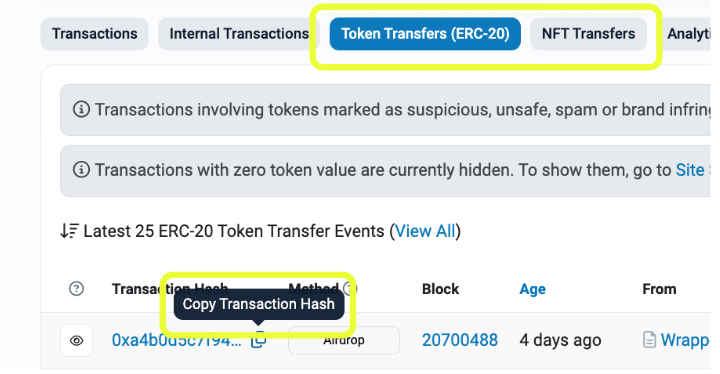
* Under the **Token Transfers (ERC-20)** tab, find the transaction related to FT assets.
* Navigate to the **NFT Transfers** tab to find NFT assets. By looking at the asset item or the transfer time, you may determine whether transaction is accurate.
FT/NFT Tabs & Copy a Tx hash
Copy a Tx hash
4\. Make a copy of the transaction hash.
5\. Pick the source chain's network in the HAVAH Mitter Help Center, enter the copied tx hash in the input box, and continue.
Help Center
By going to each chain's explorer or scanner, you may apply the same process to get the tx hash for that chain.
* Chains supported: BASE, WEMIX, Klaytn, Polygon, XPLA and BSC
* Unsupported chain: At the moment, Meverse is not supported. Please submit a Discord ticket if you need help.
* Solana and Aptos: Not yet determined.